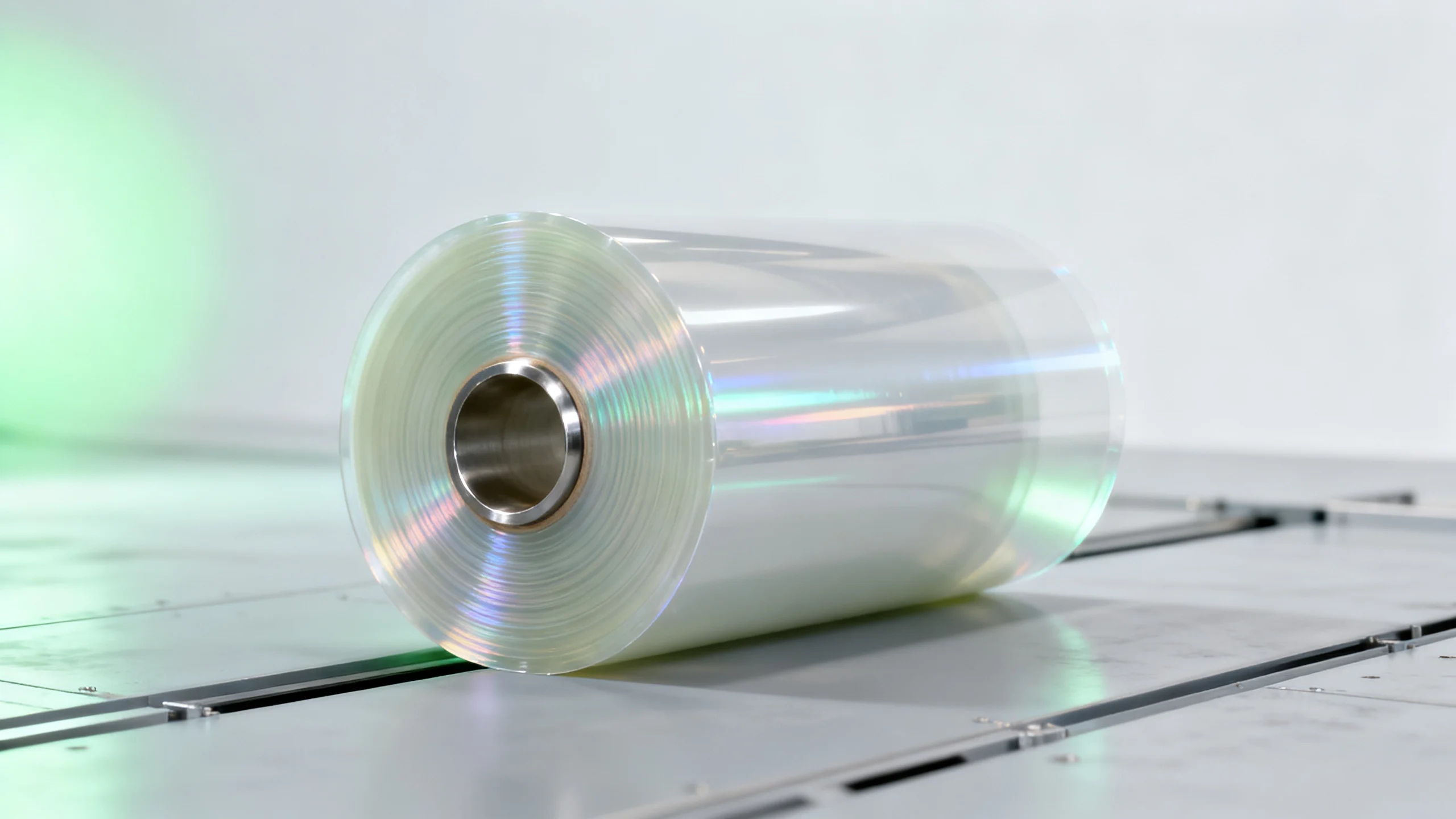
Every layer of a high-barrier film is melted simultaneously and bonded in a single die. That single fact explains most of the performance and most of the sustainability story of modern barrier packaging.
Why one die changes everything
Conventional multi-layer films were laminated: separate films joined with adhesives. Lamination introduces solvents, drying ovens, adhesive layers and a delamination risk that lives in the pack for its whole shelf life. Co-extrusion removes all of it. Nine polymer streams meet in one die and leave as one solid, bonded structure.
The die and the layer order
Layer order is engineering, not decoration. A typical nine-layer structure runs: outer PA for mechanical strength and print, a tie layer, the EVOH barrier core, another tie layer, and a PE seal layer for heat sealing and oil resistance. The gauge of each layer is set by the die design — the barrier core might be 5 % of the total thickness, but it delivers most of the function.
Why the barrier core sits in the middle
Placing EVOH between structural layers protects it from two directions at once. The outer PA blocks the mechanical damage and moisture ingress from handling; the inner PE seal layer blocks moisture from the product side. The barrier only has to be good, not durable.
Water quench: the difference you can see
Down-blown water quench film is cooled in a chilled water bath rather than with air. The rapid quench produces a finer crystalline structure, which raises clarity and tear resistance. This is not a subtle manufacturing preference — it is visible in the finished pack, and it is why water-quench film commands a premium in meat and seafood.
What the process controls
- Gravimetric dosing keeps thickness variation at 2 Sigma 2 %.
- Online monitoring tracks gauge, tensile, heat seal and optical properties during the run.
- Inline thickness measurement prevents an entire reel drifting off tolerance.
The environmental case
Because no solvent and no adhesive are used, the co-extrusion route removes the largest single emission source in multi-layer film conversion. It is also the route that makes mono-material PE/EVOH/PE possible: one material family, one recycling stream, one disposal instruction for the consumer.
The next generation of barrier films will be judged on two numbers: how well it blocks oxygen, and how easily it can be recycled after it has done its job. Co-extrusion is the technology that answers both.